


In today’s digital, highly regulated, and threat-intensive environment, organizations face a fundamental challenge: how to scale responsibly while maintaining trust, resilience, and security. Governance, risk, compliance, and security must no longer operate in silos. Together, they form the operating foundation that determines whether an organization can grow safely, withstand disruption, and retain the confidence of regulators, customers, and investors. This convergence is what we refer to as GRCS.
GRCS Trust was created to enable this shift by building an integrated, long-term platform for modern GRCS operations.
GRCS: From Siloed Controls to an Operating Model
GRCS brings together four interdependent disciplines that were historically managed in isolation:
- Governance, covering decision-making structures, accountability, and oversight
- Risk management, encompassing operational, financial, strategic, and third-party risks
- Compliance, ensuring adherence to regulatory, legal, and internal policy requirements
- Security, protecting data, systems, and infrastructure from cyber and physical threats
Today’s digital transformation, cloud adoption, and intensifying stakeholder expectations have collapsed the boundaries between these domains. A security incident no longer sits solely with IT. It now exposes weaknesses in governance, risk oversight, and compliance execution.
GRCS is no longer a reporting layer. It is an enterprise operating model.
Why the GRCS Opportunity Is Accelerating
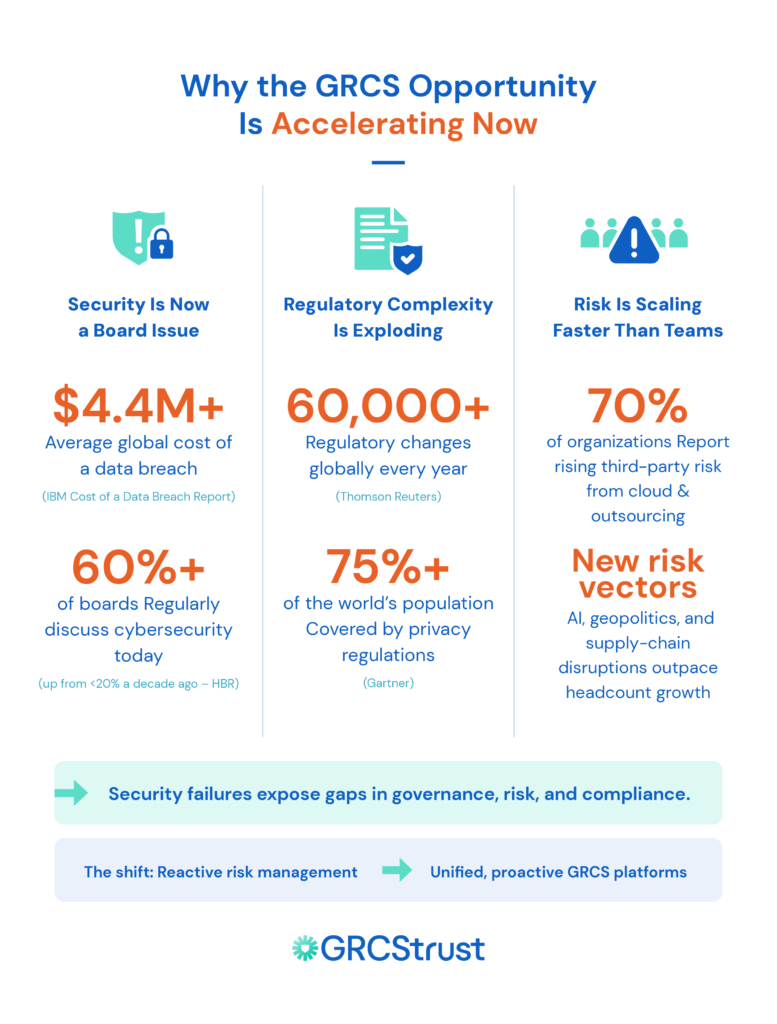
1. Security Is Now a Board-Level Concern
Cybersecurity incidents are no longer isolated technical events. They represent enterprise crises with material financial and strategic impact.
According to the IBM Cost of a Data Breach Report 2025, the global average cost of a data breach was USD 4.44 million, remaining a major financial burden for organizations worldwide.
In parallel, a Gartner survey found that 88 percent of boards of directors now view cybersecurity as a business risk rather than a technology issue. This reflects the fact that security, risk, and governance are increasingly discussed at the highest levels of leadership.
Security outcomes increasingly reflect the strength of governance frameworks and risk-based decision-making, making GRCS inseparable in practice.
2. Regulatory Complexity Is Expanding
Organizations today face overlapping regulatory obligations across privacy, financial reporting, operational resilience, and security frameworks. Keeping manual, siloed controls up to date with regulatory change is becoming increasingly difficult.
Thomson Reuters Regulatory Intelligence notes that the volume and complexity of regulatory changes are forcing organizations to invest in scalable, technology-enabled compliance processes to keep pace with updates.
Centralized visibility and unified control frameworks, which are core features of modern GRCS platforms, are no longer optional but essential.
3. Risk Is Increasing Faster Than Headcount
Third-party and supply-chain exposures are creating new risk vectors that traditional risk and compliance teams cannot manage manually. Research from Secureframe shows that breaches involving third parties are common and materially costly, with a majority of organizations reporting third-party breach experiences.
This underscores the urgency of integrated GRCS platforms that connect security, compliance, and risk data into a single, actionable system. Such platforms enable proactive risk management rather than reactive firefighting.
4. Trust and Resilience Are Valuation Drivers
Strong GRCS practices are increasingly tied to enterprise valuation and strategic trust. Organizations with mature risk and security programs:
- Experience fewer operational disruptions
- Recover more quickly from incidents
- Demonstrate stronger outcomes in investor and partner due diligence
Investors, lenders, and enterprise customers now actively evaluate governance, risk, compliance, and security maturity during strategic engagements. This elevates GRCS from a defensive function into a competitive differentiator.
The Role of GRCS Trust
GRCS Trust is a permanent-capital platform purpose-built to enable this new enterprise reality.
Rather than offering a point solution, GRCS Trust integrates best-in-class governance, risk, compliance, and security capabilities into a coherent ecosystem. This unified platform replaces fragmented tooling and disconnected data with a consistent operational foundation.
The GRCS Trust platform aims to deliver:
- Unified visibility across governance, risk, compliance, and security
- Security-by-design embedded directly into business workflows
- Automation-first capabilities to reduce manual effort and human error
- Executive-ready insights that translate technical risk into business decisions
With GRCS Trust, CISOs, CIOs, and risk leaders gain a single source of truth and a coherent operating system that supports continuous control and regulatory readiness. This enables a shift from reactive audit response to proactive operational resilience.
Why GRCS Trust Matters Strategically
By enabling GRCS as an integrated operating platform, organizations realize:
- Stronger security posture with fewer blind spots
- Lower regulatory and breach-related costs
- Faster, more confident growth decisions
- Greater trust with regulators, customers, and investors
In an environment defined by uncertainty and persistent threat, GRCS is no longer merely a defensive compliance function. With GRCS Trust, it becomes a strategic capability that supports sustained growth, resilience, and trust.
Sources Cited
- IBM Cost of a Data Breach Report 2025, IBM. Global breach cost data and trends.
- Gartner Board of Directors Cybersecurity Survey. Percentage of boards viewing security as a business risk.
- Thomson Reuters Regulatory Intelligence insights. Regulatory change and compliance context.
- Secureframe third-party risk analysis. Prevalence and impact of third-party breaches.
Source URLs
IBM Cost of a Data Breach Report
https://www.ibm.com/reports/data-breach
Gartner: Boards View Cybersecurity as a Business Risk
Thomson Reuters: Cost of Compliance and Regulatory Change
https://legal.thomsonreuters.com/en/insights/articles/cost-compliance-changing-world-regulation
Secureframe: Third-Party Risk Statistics
https://secureframe.com/blog/third-party-risk-statistics
Gartner: Privacy Regulations Coverage